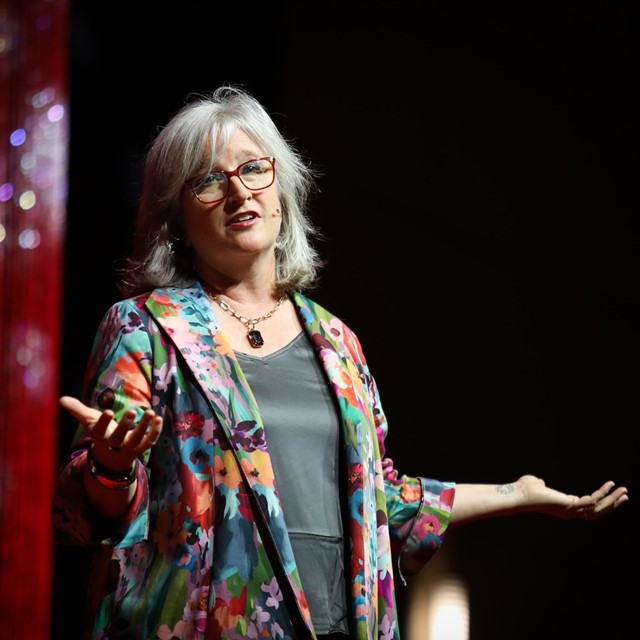
Elise Partin speaking, photo by TEDx Congaree Vista
People gathering to listen to speakers, eager to be enlightened and inspired. It is, of course, the kind of event that warms our hearts at The Buckley School.
So when Buckley coach Elise Partin signed on to deliver a TED talk at TEDx Congaree Vista, we were excited to cheer her on. Now, we're following up to see what she learned from the experience and how those lessons can help you.
What's a TED Talk?
Though TED has been around for more that 40 years, we still have people ask us this question. If you'd like to dive into the details, you'll find them here. We like to think of it as a modern-day Chatauqua, a chance for people to hear speakers on a variety of subjects and entertain new ways of thinking. While TED provides a huge platform, TEDx events specifically bring together speakers and audiences at a more personal, community level.
The format for TED talks is known for its ability to make complex topics accessible, challenging people to move away from academic and corporate lingo. The TED presentation style also pushes speakers to deliver in ways that build audience rapport.
Lessons from TED to help you
Her most recent talk wasn't Elise's first time speaking at a TED event. She'd also given a TED talk in 2015. Here's how she answered our questions about preparing and delivering this time around.
How did your preparation this time compare to your last TED talk? What was different about the way you approached it?
Elise: Stepping back onto the TEDx stage 10 years later was less stressful in some ways but in other ways was even more, because I knew what's expected of you. One subtle thing we teach at The Buckley School is to ask for help from friends or colleagues about our message. That was really critical for me this time. There was so much to the message I was sharing. I couldn’t figure out how to get started. Getting a friend to bounce around the big idea with helped.
What do you like about this forum for public speaking?
Elise: On a TED stage, there are no teleprompters. There's just you, your audience, and your big idea. If we're going to help people see our idea is worth thinking about, we have to put in the work to say what we want in the fewest, most striking words possible. We have to paint pictures. We have to take our audience on a journey. That two selection committees thought my ideas are worth sharing out of thousands of applications is exciting, of course. As a public speaking coach, giving that type of talk also means I have more experiences I can draw on for our clients.
What lessons for speakers can you share from this round?
Elise: Number one for me is finding a positive way to deal with nerves. Our goal is not to get rid of nerves. Nerves mean we care. What helps me is to recall why I'm doing this. As speakers, we can remember we believe in our message. We have something that benefits the audience. We know we can create positive change. Whatever it is, if we can focus on that, it takes the pressure off of us.
That was really critical for me this time because I was the first talk of the day. And as first talks go, I was the one who got to help work out kinks in the audio. My microphone didn't cut on when I first entered the stage. Thinking about my audience instead of myself, I was able to quickly assess two things: 1) Did the in-house audience hear those first few words? Having done practice runs, I knew they did even without my mic working. And 2) I knew our audio team was amazing and could tweak that before it lived on the internet forever. If I had been worried about my vanity in that moment, it would've tripped me.
That gets me to another lesson reinforced by this experience: If an idea is worth sharing, then it's worth investing in. A TED stage done right is about getting every word working in concert, making sure your message connects with your audience. That takes time. But it's worth it.
We're thinking about the saying: There are three speeches - the one you prepared, the one you gave, and the one you wished you'd given. Reflecting on your latest TED talk, what worked well? What might you have done differently?
Elise: Even though we focus on the benefit for our audience, we're still the one delivering the message. We're people. Life happens. At the time of giving this second TEDx talk, I was in the middle of a stressful time as a mayor. It sapped some of my energy and temporarily shook my confidence just the tiniest bit. Then, I stepped onto the stage and the mic wasn't on.
If those two things had been different, could I have delivered with a little more ease? A little more energy? Maybe. But that's how life goes and that's how public speaking goes. It's a great reminder: If we prepare well, then no matter what happens we'll still be able to connect our message with our audience.
Also, we should be having a little bit of fun! It's an honor and a gift to be able to stand up in front of people. If we're having fun, then an audience will too.
LEARN MORE
Here's a look back at Elise's first TEDx talk and the lessons she shared from that experience.
Practice is a big part of delivering well. Learn from a TED talk that explores how Demosthenes and Beyonce use deliberate practice to enhance performance.
TED is known for putting speakers on stage without a lectern or notes. But what if you need notes? Find our tips for using notes when there's no lectern available.


