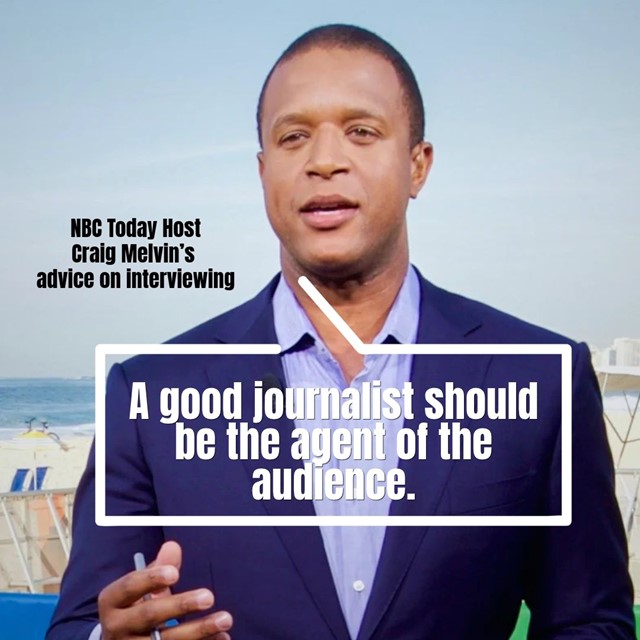
"A good journalist should be the agent of the audience," says NBC Today host Craig Melvin in his tips for conducting a better interview.
His comments are part of a resource library for emerging journalists, produced for NBCU Academy. As we watched the video, it struck us that his advice for interviewing offers insights for those of us moderating panel discussions or anyone who is being interviewed, as well.
Audiences, he points out, want to learn something. They respond to emotion. They count on the interviewer to act on their behalf, to ask the questions that clarify a point or get to the heart of a matter.
Here are some of his tips and our thoughts on how they apply when you're moderating a panel or being interviewed by the media. We've also included Craig's video, so you can watch it and see how his advice strikes you.
Tip: Shorter questions elicit longer answers
Melvin says his experience has shown him that when you ask a short question, you give the responder more space to open up.
For panel moderators, consider:
- Providing less background or set-up for the question you're asking. Phrase your questions more tightly.
- Breaking down multi-part questions into a series of shorter questions. This promotes a more give-and-take, conversational style of speaking with your panelists.
For interviewees:
- A short question may give you more time to speak, but don't let it be an invitation to ramble.
- Do add emotion or your expertise, where it's appropriate and needed. That's one of the things you have to offer in an interview.
- If a question IS long and the set-up almost answers the question before you can, don't let that dim your light. Restate key ideas or elaborate on the part you want to convey. Add something.
- Don't feel you have to rush to give your answer. Here's what Melvin says about a pause: "When you can see someone look down, or look up, or pause for a beat or two, that's the sign of a good interview."
Tip: Go deep, not wide
Melvin suggests interviewers focus on no more than three core topics, rather than trying to speed through five or six different subjects in a short amount of time.
For panel moderators, the Rule of 3 can be a helpful concept as you coordinate with panelists, fine-tune the topics you'll cover, and give panelists more time to respond and react to each other's comments
For interviewees,
- We recommend you go to interviews with a plan—a key message and no more than three points you want to make in your interview.
- Even when interviews run longer (as on podcasts), having three key points in mind helps you keep your focus and avoid veering over to other subjects that will water down your messaging goals.
Tip: Prepare themes, not a script, and practice active listening
Once they've focused on the topic, journalists should organize their thoughts around themes, Melvin suggests, rather than read scripted questions. This approach, he says, lets interviewers stay more engaged with the people they're talking to, so they can listen more fully and respond to what they're hearing.
For panel moderators, the ability to listen, unpack a panelist's answer, or connect and contrast viewpoints are valuable services to the audience. A panelist should:
- Listen to answers from one speaker and encourage others to offer their take.
- Act as an agent for the audience, helping to clarify terms, ask for background, or seek out other information that makes information more accessible.
For interviewees, we recommend preparing your answers to the questions you expect to get and use bridging to get to your points. Those instructions can feel counter to this advice from Melvin—but they shouldn't be:
- Listen to the question and acknowledge it, even if you're going to bridge to another point.
- When you memorize your answers and try to repeat them, you may sound robotic or falter. Familiarize yourself with your key themes and key phrases, instead.
A model for friendly professionalism
As a news anchor and host, Craig Melvin provides a good example of how you can be serious, firm, and professional, while still remaining calm, friendly, and likeable. And we're not saying that just because we know him from his early days as a news reporter in South Carolina.
In the video, Melvin says, "Make it about the subject." Putting the message front and center is always good advice—and helps you remember that when you communicate, it's not all about you.
And he recommends finding a place for being your warm, friendly self: "There should be a smile. There should be a moment in every interview where you can just be normal."
LEARN MORE
When you're being interviewed, you should have a purpose and a plan. Find our tips for getting your thoughts together.
How can you be a more effective participant in a panel discussion? Here's some advice.
If you're moderating a panel, the audience is counting on you. Make your plan to be the guide they need.
See why "that’s a good question" may not be a response journalists want or one that helps you advance your cause.