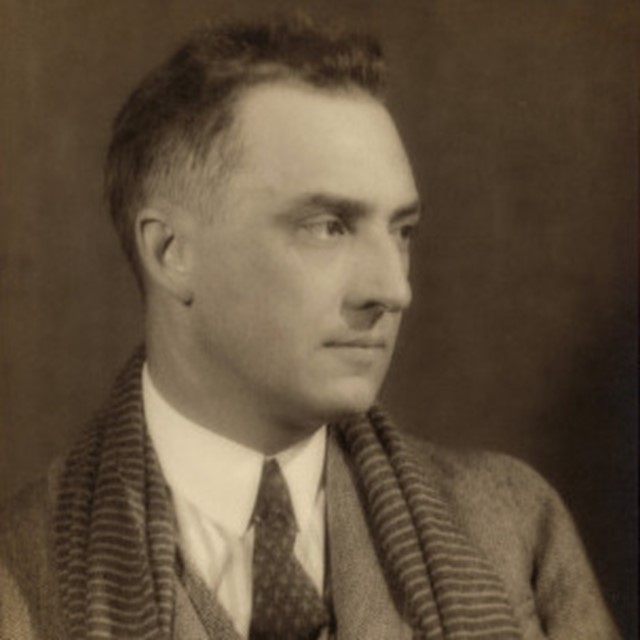
The Buckley School's founder believed that all public speakers should hone their presentation skills by reading poetry out loud. We keep that worthwhile practice alive by including a poem in our magazine each month for you to read aloud. Above, William Carlos Williams, photographed in 1924 by Man Ray.
"There is no optimistic blindness in Williams, though there is a fresh gaiety, a stubborn or invincible joyousness."
– Randall Jarrell
With a grandmother named Emily Dickinson, perhaps William Carlos Williams was destined to be a poet. Nevertheless, his parents insisted he study medicine and Williams worked as a doctor for more than 40 years, all the while writing poems, plays, novels, and essays.
Williams was born in 1883. His father was English, his mother Puerto Rican. He grew up in Rutherford, New Jersey, where the family spoke Spanish and his upbringing was influenced by Caribbean culture.
Becoming friends with Ezra Pound at the University of Pennsylvania, Williams joined Pound and other poets to form the Imagist movement and was an inspiration to poets of the Beat generation.
He found his subject matter, he said, by listening to his patients. His writing style was driven by his desire to reflect natural, American ways of speaking—as opposed to the more formal English words and phrasing of his contemporaries like T.S. Eliot.
"The purpose of an artist, whatever it is, is to take the life, whatever he sees, and to raise it up to an elevated position where it has dignity."
– William Carlos Williams
Williams tried to write every day, even as he managed the demands of being a family doctor and caring for his own family, a wife and two sons.
Williams won the National Book Award for poetry in 1950 and the Pulitzer Prize, posthumously, in 1963.
 Williams poem at The Hague. Photo by Vysotsky - https://commons.wikimedia.org/w/index.php?curid=37567227
One of his best-known poems is "This Is Just to Say," which has been commemorated on a wall at The Hague.
Below is a poem by Williams for you to read aloud, one you can use to help you attempt more contrast and color in your vocal delivery.
Blizzard
Snow:
years of anger following
hours that float idly down —
the blizzard
drifts its weight
deeper and deeper for three days
or sixty years, eh? Then
the sun! a clutter of
yellow and blue flakes —
Hairy looking trees stand out
in long alleys
over a wild solitude.
The man turns and there —
his solitary track stretched out
upon the world.