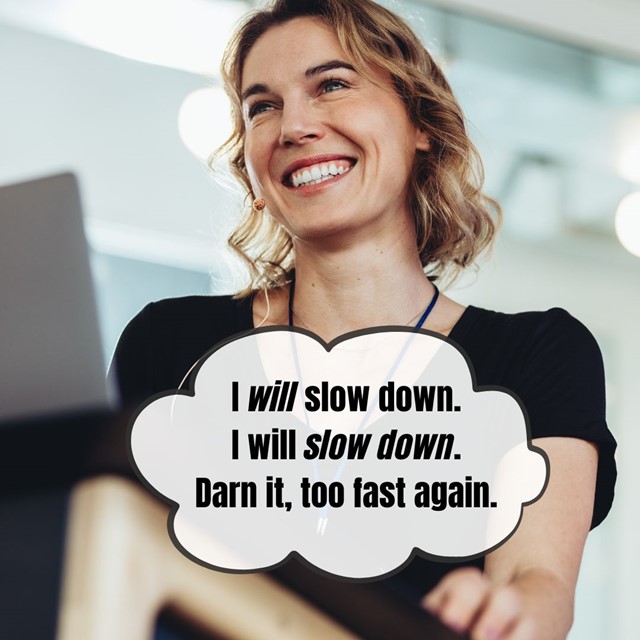
I'm just naturally a fast-talker.
The adrenaline kicks in and I'm off to the races.
I'm super nervous—and want to get this over for me and for them.
Spanish is my first language. Am I really speaking English that fast?
There are any number of reasons a person might speak too quickly when making a speech or presentation. We understand. The result, though, is often the same: When you speak too rapidly, your audience can't keep up.
Controlling your pace helps everyone
The most important reason to slow too-fast speaking is that your audience needs for you to speak at a reasonable rate if they're going to comprehend your message. Consider:
- You know what you want to say but the audience is hearing it for the first time.
- When we listen to information, we often need a moment to consider it before we can move to the next point.
- There is no pause or rewind button. Audiences have to grasp information on the fly.
- Not only is your information new to them, but so are you—your accent, your inflections, your way of putting words together. They have to adjust to that, too.
Being able to slow yourself down is an advantage for you, too, even if you believe that speaking quickly is your most natural mode.
- Slowing your speech gives you the chance to breathe, articulate your words, and be more expressive in your delivery.
- If you are a nervous speaker, slowing your rate of speech conveys confidence—even when you’re not quite feeling it yet.
- Being able to vary your speech—speaking slowly at times, more quickly at others—gives you yet another way to communicate the message behind your words and make your presentations more engaging.
What you can do
Whether you've been told you speak too fast all your life or you're battling nervous energy when you present, here are some ways to approach your pace and get it under control.
1. Understand HOW you're rushing
In our coaching, we see speakers rush in a couple of ways. Some race through the entire message at a fast rate, never pausing. Others rattle out groups of words as if they're firing their thoughts from a machine gun. Getting a handle on how and where you rush your words helps you better address the problem of too-fast delivery.
For example, we've had speakers slow their overall pace but because they’re a machine gun speaker, audiences are still unable to grasp key words. When we recognize that words are firing out in bursts, we can work on varying cadence—either slowing down those phrases or changing up where the speaker pauses.
2. Exaggerate and get some feedback
What feels slow to the speaker may still be too quick for the audience. As with so many aspects of public speaking, we may not have an accurate perception of our delivery. We may believe we have slowed our speaking, but we haven’t.
To get a feeling for your rate of speech, exaggerate speaking slowly. Have a few people listen to you present and give you feedback. How did your pace feel to them? If they say it was the right pace—slow enough to be engaging, not so slow as to be dull—then see if you can replicate it for them. Notice how it feels to you.
3. Over-articulate
One technique that slows most speakers is to make a point of deliberately putting the end on each word. Forcing yourself to strongly enunciate final consonants tends to slow a speaker down.
You might try exaggerating this technique in practice, then seeing if you can gently smooth it out in your regular delivery. Crisp diction, by the way, is one of the audience-appreciated improvements any speaker can make, whether they rush or not.
4. Pick your spots
Pace throughout a presentation should ebb and flow. There are times when a speaker should be slower, times when they should lift the pace up. It's one more way to bring variety to a talk, and variety is a key to keeping audiences engaged.
So rather than think, "I must become a slow talker despite my natural tendencies," consider how you can deploy a slower rate of speech as part of your strategy:
- Speak more slowly to start—when audiences are just getting to know you and your topic.
- Slow a key sentence and speak it word by word for emphasis or drama.
- Slow down to present something complex.
- Use pauses to promote understanding and to build anticipation.
5. Create some visual cues
When you're using notes or delivering a speech from a script, you can also put in reminders to slow down. Yes, you can write "speak slowly" at the top, in the margins, or on a sticky. You might also:
- Space lines and words on the page.
- Put larger breaks between sections.
- Underline or highlight passages you want to especially slow down.
- Bracket reminders to pause.
6. Practice in casual conversation
While many of us don't present every day, we do speak to people in dozens of different ways. If rushing is an overarching quality in the way you speak, start experimenting with pace in conversations. Slow down the next time you place an order in a restaurant. Try pausing or over-articulating when you speak to family or friends. You might even let a colleague or loved one know you're trying to change up your rate of speech and get them to notice when you do.
The quick fix that makes you more impressive
Slowing your rate of speech is both possible and essential—two notions we work hard to instill in the speakers we coach. Whether you rush in pressure situations or it's the natural pace at which you speak, fast talking can work against you when you're trying to get your message across and inspire confidence.
If you'll think about pace as another tool you have to use as a speaker, the motivation to control and vary yours may feel more compelling. Take some time, practice a little, and see how you might find ways to slow down in your presentations when it matters most.
LEARN MORE
For insights on how pausing can be powerful, see these thoughts from our founder.
Variation is the speaker's friend. Find some tips for how to bring more variety to your talks.
If appearing more confident is your goal, pace is one piece of the puzzle. Here are some more easy ways to enhance your executive presence.


