The Buckley School's founder believed all public speakers should hone their presentation skills by reading poetry out loud. We keep that worthwhile practice alive by including a poem in our magazine each month for you to read aloud.
If we know the writer Matthew Arnold it may be because his poem "Dover Beach" is read in many classrooms of English literature and discussed as a precursor to modern poetry.
Arnold was born in 1822. His father was headmaster of Rugby School, and Arnold's family spent summers in the Lake District, where William Wordsworth was a neighbor and close friend.
Arnold graduated from Oxford, wrote, and held a number of jobs. He was appointed an inspector of schools in 1851. He described the work as drudgery, though it gave him the opportunity to travel across England in the early days of the railway.
 Caricature of Arnold by James Tissot published in Vanity Fair in 1871
Meanwhile, Arnold continued to write, publishing volumes of poetry, essays, and other work. He was elected Professor of Poetry at Oxford in 1857. As he matured, his body of work and reputation continued to grow. In the mid-1880s, he traveled the U.S. and Canada with Ralph Waldo Emerson, delivering lectures on education and democracy.
Arnold died not long after and rather suddenly, in 1888, from heart failure. Arnold was running to meet a tram that was bringing his daughter on a visit from the United States to his home in Liverpool. His daughter had married a New Yorker she'd met during his lecture tour.
Below, for you to read aloud, one of Arnold's shorter poems with a grass-is-greener theme that can help you explore the power of well-timed pauses.
Youth's Agitations
’When I shall be divorced, some ten years hence,
From this poor present self which I am now;
When youth has done its tedious vain expense
Of passions that for ever ebb and flow;
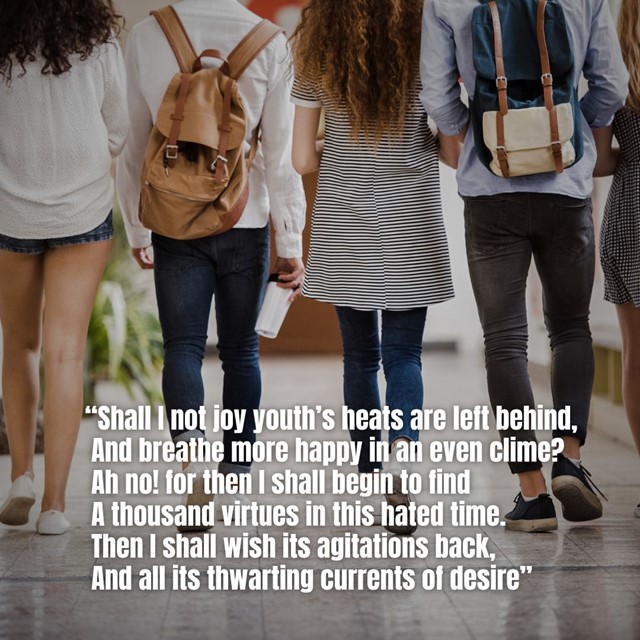
Shall I not joy youth’s heats are left behind,
And breathe more happy in an even clime?
Ah no! for then I shall begin to find
A thousand virtues in this hated time.
Then I shall wish its agitations back,
And all its thwarting currents of desire;
Then I shall praise the heat which then I lack,
And call this hurrying fever, generous fire,
And sigh that one thing only has been lent
To youth and age in common discontent