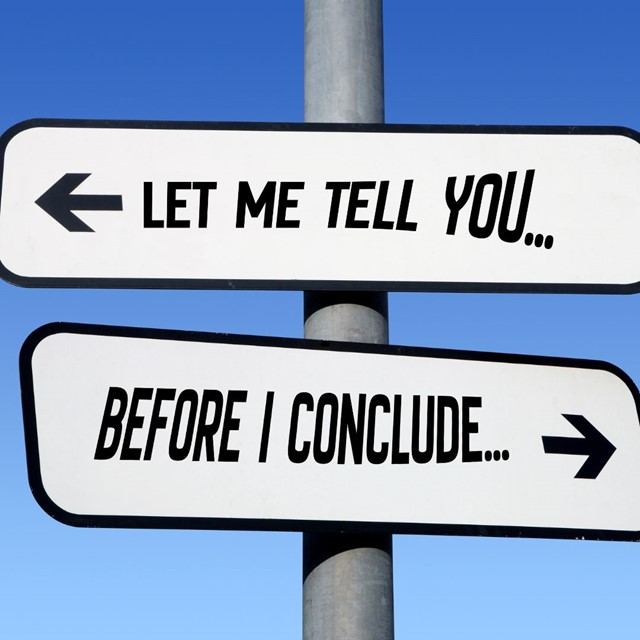
You definitely hear them. Most likely you use them. Signposts are the phrases that connect your ideas, set up what's coming, create emphasis, and guide your audience:
First…next…finally
Let me be clear…
Here’s what you need to know…
Most important…
Let me tell you…
As George Mason University's writing center says to students:
Signposts are helpful to readers, but overusing them can make your prose wordy or suggest you don’t trust your reader.
Like every technique a speaker or presenter can deploy, using signpost phrases requires consideration and your judgement. Let's look at the pros and cons.
How signposting can help
Here are some of the ways signposts can make your message more readily understood.
Guiding your audience through your material
Enumerating points can help you audience follow along. Saying "here’s an example" before you provide one is useful. Making it clear when you're quoting someone else's words is another way signpost language can help your audience.
Encapsulating complicated information
For example, if you've presented a complex situation and want to capture its essence, you might be warranted in saying "let’s be clear" before you state the primary takeaway. If there's a conclusion you want an audience to reach, you might set that up with a signpost before you state it: "What we can conclude is…"
Showcasing a key idea
Yes, a phrase like "Here's the important point…" can help the audience focus on what's next.
How these signal phrases can get in your way
When we work with speakers, we often suggest that they eliminate some of their signpost phrases. Here's why:
Repetition of crutch phrases
Speakers often become attached to a word or phrase. It becomes clear that they are using it as a form of filler for themselves. For example, when a speaker says "literally" or "what’s important here" five or six times in a speech, that phrase has less impact and starts to sound like the fluff it's become.
Cliched expressions
While "the bottom line" and "at the end of the day" do communicate the idea of here's what you should conclude, they are also overused. Combine a cliched expression with careless repetition (see above) and you're undermining your message, not making it clearer.
A condescending or preachy tone
Speakers should monitor tone and take care with phrases like "let me tell you" or "I want you to consider." Said once in a speech, a phrase like that can be fine. But repeated, it can make a speaker sound as if they have all the answers for their poor, dumb audience, or that they're over-selling an idea.
Set up you don't need
Speakers sometimes use signpost phrases when they don't need them. One example is some variation of the phrase "let me tell you a story." Many times, a speaker can simply pause for a beat and begin the story—and be more effective.
An invitation to tune out
When a speaker says "in conclusion" or "before I wrap up," we've noticed that audiences start tuning out right away -- long before the speaker concludes, in some cases. The audience mentally packs up; some even physically pack up their bags and get ready to leave.
Alternatives to signpost phrases
As you consider whether you need to use a signpost, think about other ways you can achieve the same effect without dumping extra words on listeners. Here are a few ideas.
Pace and pausing
Rather than a set-up phrase, you might try delivering a sentence more deliberately. So instead of "Let me tell you, this was a bad idea" for emphasis, you could say "This (pause) was (pause) a bad (pause) idea." If you're moving into the conclusion of your message, try taking a pause or slowing the pace of your delivery instead of saying "as I wrap up."
Tone change
For example, rather than saying "I want you to consider…" you might try a using contemplative tone and rephrase as a question "What would happen if…. "
Body language and gestures
Instead of "let me ask you," how about a shrug to lead into your question? Or a definitive gesture to signal "bottom line" instead of saying the words?
Before we conclude…
There's a place for signposting in messages, and these phrases can help your audience when you use them with purpose. If you know you have a tendency to rely on filler, though, look for other ways to achieve the effect you want.
LEARN MORE
For some tips on how to build better transitions into your presentations, see this.
We've identified some filler phrases you might want to reduce. Find them here.
Is that phrase a signpost, or is it verbal flatulence? Our founder weighs in here.